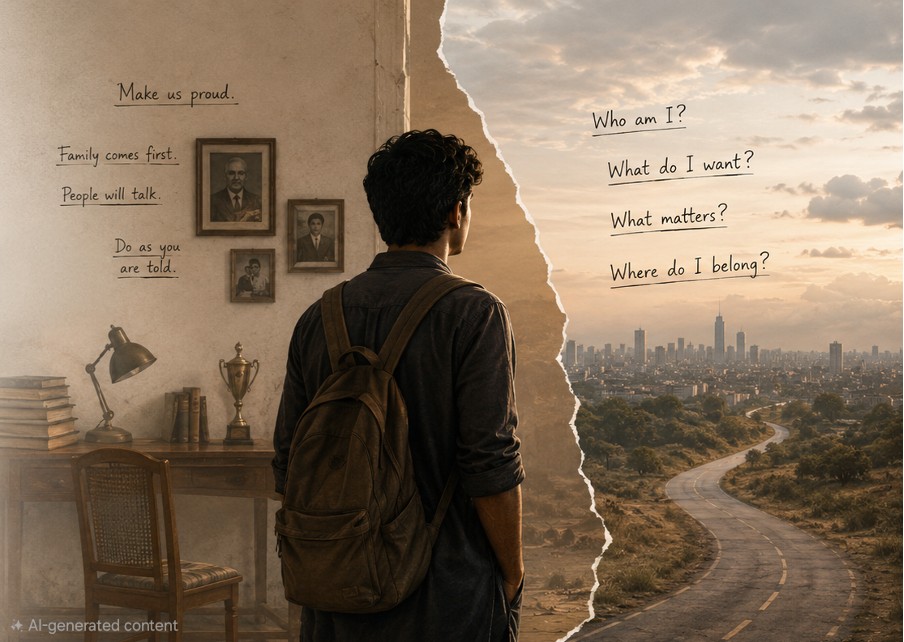
The World They Built For Us
How homes in the sub-continent raise children for a reality that doesn't exist, and what it costs them.
Nobody tells you, when you're growing up, that the world your parents described might not be the real one. You only find out later — when life refuses to follow the rules you were handed.
There is a particular kind of confusion that hits many people in their twenties. Not the ordinary confusion of new responsibilities or failed plans. Something deeper and harder to name. A feeling that you are fundamentally mis-equipped, that you arrived at the game of life holding the wrong rulebook, dressed for weather that doesn't exist.
This is about where that rulebook comes from. It is about how families construct an entire version of reality inside the home. A version that may feel warm and certain while you live inside it, but that quietly sets you up to struggle the moment you step outside.
Before we knew the world, we knew our home
Think about what a home actually is! It is not just shelter. It is the place where a child builds their first understanding of how reality works. What is true. What is expected. What is dangerous. What makes you worthy of love.
Parents are, whether they intend it or not, world-builders. Every family runs on an internal logic; a set of unspoken rules, beliefs, and values that the child absorbs not through instruction but through the air of daily life. And crucially, none of this is presented as one opinion among many. To a child, it is simply the way things are.
This is not a flaw in parenting. It is a feature of childhood. Children are, by design, believers. They have to be, they have no other reference point. The problem arises not from the fact that families construct this reality, but from what that reality contains. And when the domestic world diverges significantly from what human beings actually need, and what the actual world actually demands. The child is being quietly prepared for a life that doesn't exist.
Four false realities that homes build
Let's be specific. These are not exotic or rare patterns. They are common features of subcontinental family life that operate quietly, usually with love, and almost always without awareness of the damage they do.
Love equals obedience
Children learn that love is a reward for compliance. To question is to disrespect. This becomes a life-long belief: “I am worthy when I submit.”
Image above all
The family's reputation, izzat, is the highest value. Children learn that suffering is fine, but visible suffering is the real problem.
The pre-written script
What to study, who to marry, how to live, decided before the child could choose. The message: your inner world does not matter.
Emotions are weakness
Anger, sadness, fear, all treated as drama or failure. Children learn to hide their inner life. They never learn to understand it.
Each of these teaches the child something false about how life works. Love does not require constant submission. Your inner life is not an inconvenience. Other people's opinions of your family are not more real than your own pain. But the child doesn't know that yet. They won't know it until the world, which operates on entirely different rules, teaches them otherwise.
Why it hits the subcontinent harder
Intergenerational trauma. The subcontinent's modern history is one of extraordinary collective suffering. Poverty, violence, feudal hierarchies. Trauma of this scale does not end when the event ends. It lives in how people parent. Hypervigilance, rigid control, emotional unavailability, these are the parenting signatures of unprocessed fear. Parents pass on not what they intend to, but what they carry. And children absorb it without any map for what it means.
Collectivism without space for the individual. Collective family culture is not inherently harmful as much in subcontinent, it can be a profound source of support and belonging. The problem arises when collectivism functions as an erasure of individuality rather than a support for it. When “family first” becomes a demand that you have no self separate from the family's needs and image, it stops being community and starts being control.
The silence around mental health. Pakistan has roughly one psychiatrist for every 500,000 people. But the more damaging scarcity is not of professionals, it is of language. Across much of the region, there is no legitimate cultural vocabulary for psychological suffering. Mental illness is weakness. It is spiritual failure. It is something to be hidden, prayed away, endured. The person who is drowning is told to swim harder and thank God for the water.
The result is generation after generation carrying significant psychological weight, with almost no legitimate means of setting it down.
When the constructed world meets the real one
The collision is usually not dramatic. It does not arrive as a single moment of revelation. It arrives as a slow accumulation of friction, the growing sense that something is wrong, that you are not equipped for something you can't quite name.
The world does not reward obedience as such. It does not care about your family's izzat. It does not follow the script. And the person who was raised to navigate the domestic reality finds themselves, in the actual world, holding tools sharpened for demands that will not be made and unarmed for the demands that will.
This is not a metaphor. It shows up clinically: as anxiety that has no obvious trigger. As depression in people who “have no reason” to be depressed. As a profound inability to form close relationships, because every relationship they learned about was conditional. As an identity crisis in the middle of a life that looks, from the outside, perfectly fine.
Many people in this position spend years believing they are simply weak, broken, or ungrateful. It rarely occurs to them because it was never offered as a possibility, that the problem is not them. The problem is the gap between the world they were given and the world that is.
What can actually change things
This is not a problem that resolves easily, and it would be dishonest to pretend otherwise. The home-reality a person was raised in is not merely a set of beliefs they hold. It is the lens through which they see. Questioning it requires seeing the lens itself which is, by definition, the hardest thing to see.
But it is possible. And it tends to begin with one simple, unsettling recognition: that the way things were in your home was not the way things have to be. That the rules you were given were not the rules of life — they were the rules of your particular family, shaped by their particular fears and history and limitations.
On a cultural level, change requires something harder: the willingness to talk about mental health as a real and serious matter. Not as weakness. Not as ingratitude. Not as something to be fixed by more prayer and less feeling. But as the natural consequence of being human in difficult conditions — conditions that can be understood, and sometimes changed.
And on the level of parenting itself, the question worth sitting with is this: are you raising your child to live in the world, or to live in your version of it? The two are not always the same. And the distance between them is, for many people, where the trouble begins.